
Blog Post Title Four (Copy) (Copy)
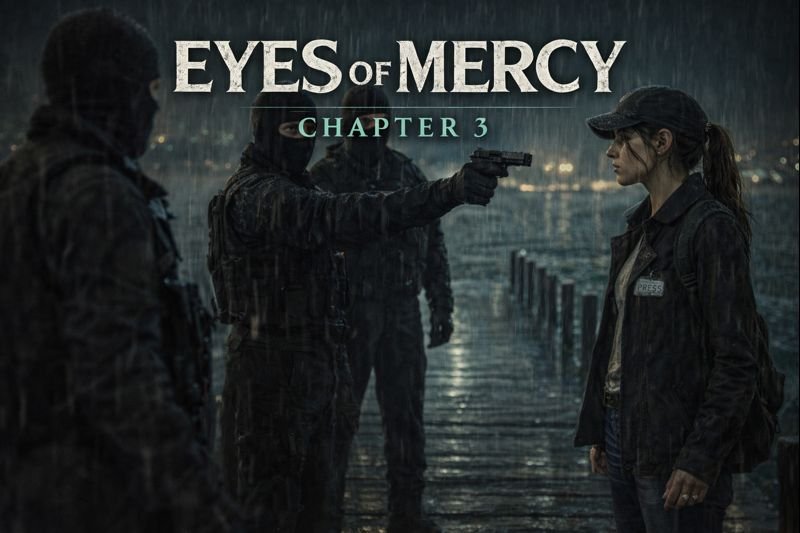
Eyes Of Mercy — Chapter 3: Kill Switch
Rain pressed against the city like a decision.
Not soft. Not forgiving. Just constant—slicking the streets, blurring the lights, turning every reflection into something distorted. The air smelled of wet concrete, exhaust, and metal.
Simone Lawson moved through it calmly.
Her hoodie was pulled low, dark jeans soaked at the hem, boots quiet against the pavement. The engagement ring stayed on her finger—not for sentiment, but for grounding. A reminder of who she was fighting for.
The burner phone sat heavy in her pocket.
She hadn’t turned it on since the library, but the message lived in her head:
STOP DIGGING.
WE NEED YOU ALIVE.
FOR NOW.
“For now,” she whispered.
A black SUV rolled slowly down the opposite side of the street.
Same shape.
Same predatory patience.
Simone didn’t react. She crossed with the crowd at the light and let strangers become her shield.
Because being seen wasn’t the danger.
Being isolated was.
The café was loud with comfort.
Espresso machines hissed. Cinnamon hung in the air. Someone laughed too hard near the register. Warmth wrapped around Simone the moment she stepped inside, and for half a second, it almost felt safe.
Almost.
She chose a table in the back where she could see both exits and the street reflection in the glass. Ordered black coffee she didn’t want. Took one burning sip.
Bitter. Grounding.
She pulled out her notebook and drew three columns.
WHAT I KNOW
WHAT THEY WANT
WHAT I NEED
Her pen moved quickly.
WHAT I KNOW
• Mercy Flight exists
• Hawke sealed QX files
• They searched Simone Lawson
• Black SUV surveillance
• Someone wants control, not silence
WHAT THEY WANT
• My files
• My location
• My disappearance
WHAT I NEED
• Leverage
• Proof that survives me
• A way to see them first
She wrote one final phrase:
Dead man’s switch.
Then she felt it.
The subtle pressure shift.
The sense of being watched without seeing eyes.
Simone lifted her gaze slowly.
A man near the window scrolled his phone without eating or drinking. His posture was too still. His attention wasn’t on the screen.
In the reflection, his eyes were on her.
She didn’t rush.
She stood like she’d remembered something important, slipped the notebook into her bag, and walked out—leaving her coffee untouched.
Outside, rain cooled her face instantly.
Simone moved with intention.
Into a bookstore.
Out the back.
Down an alley that smelled of wet cardboard and rust.
She checked reflections in parked cars.
No one directly behind her.
That didn’t mean safe.
It meant patient.
The black SUV turned a corner three blocks away.
Slow. Observing.
Simone changed direction again and headed toward Union Station.
Not because it was safe.
Because it was crowded.
Union Station glowed like a cathedral of motion.
Marble floors shone with rainwater. Suitcases rolled. Voices echoed. A child cried. Someone spilled coffee.
Life moved too fast for danger to strike cleanly.
Simone stopped near a row of ATMs, using the screens to watch the crowd behind her.
Two men.
One by the information desk.
One drifting toward the food court.
They weren’t panicked.
They were positioning.
Simone slipped into the restroom, locked the stall, and powered on the burner phone.
The screen lit instantly.
WE CAN END THIS CLEAN.
TONIGHT. 9:30.
WATERFRONT PARK.
COME ALONE.
Her stomach tightened.
Waterfront Park meant space. Darkness. Control.
She typed back:
OK.
Then turned the phone off again.
Tonight wasn’t intimidation.
Tonight was an attempt.
Simone took the Metro to an industrial stretch of the city where buildings looked tired and unloved.
The storage facility smelled like rubber and oil. Fluorescent lights flickered overhead.
Inside her unit: dust, bins, and a small lockbox.
She opened it.
A handgun. Ammunition. A folding knife. A second burner phone.
She checked the weapon with practiced calm—respecting its weight, its purpose.
Then she recorded a message.
“If anything happens to me,” she said quietly, “look at Mercy Flight. Look at Colonel Richard T. Hawke. And don’t believe the story they tell about my death.”
She encrypted it.
Scheduled it.
A dead man’s switch.
Now, if she vanished, she wouldn’t vanish quietly.
Overseas the base smelled like dust, fuel, and old coffee.
Jordan Lawson stood in a narrow corridor, phone pressed to his ear.
No signal.
Then a message finally came through:
I love you. If I don’t call tonight, don’t trust anyone.
His chest tightened.
He tried calling.
Nothing.
Instinct flared.
Jordan requested a secure channel.
The operations room buzzed with noise — radios crackling, boots moving, generators vibrating through the floor.
Jordan stood at the far end of the comms table, sweat cooling on his back, waiting for the encrypted channel to stabilize.
The screen flickered.
Colonel Richard T. Hawke appeared.
He didn’t look calm this time.
His uniform was crisp, but his jaw was tight. His eyes carried the kind of exhaustion that didn’t come from lack of sleep — it came from pressure.
“Captain Lawson,” Hawke said. “You’re not the only one asking questions.”
Jordan straightened. “Sir, with respect, something is wrong. My unit’s protocols are shifting mid-operation. Shipments are being rerouted without briefing. My men are being put in blind situations.”
Hawke exhaled slowly.
“You think I don’t see that?” he said quietly.
Jordan hesitated. “Sir?”
“Orders are coming down the chain faster than usual,” Hawke continued. “Some of them without context. Without clarity.”
Jordan leaned in slightly. “Then who’s giving them?”
Hawke’s gaze shifted — not away, but deeper.
“There are levels above both of us,” he said. “And lately, those levels have gone silent.”
The words landed heavy.
Jordan’s voice lowered. “My men deserve transparency.”
Hawke nodded once. “I agree.”
That surprised Jordan.
“But agreement doesn’t change the structure,” Hawke said. “We follow protocol. Even when we don’t like the shape it takes.”
Jordan’s jaw tightened. “Sir, I need to know what we’re moving.”
Hawke rubbed his temple — a small, human gesture.
“If I had that answer, Captain, you’d already have it,” he said. “Right now, all I can tell you is this: stay sharp. Protect your unit. And trust that I’m pushing for clarity just like you are.”
Jordan searched his face for deception.
He didn’t see it.
Hawke met his gaze evenly.
“You’ve earned that trust,” Hawke added. “Both of you have.”
Jordan nodded slowly. “Understood, sir.”
Hawke’s voice softened, just a fraction.
“And Captain… for what it’s worth, I’m sorry you’re being put in this position.”
The screen went black.
Hawke ended the call.
Jordan stood there in the noise and heat, unsure whether he’d just been reassured —
—or subtly boxed in.
Six floors above the city, Colonel Hawke stood alone.
Screens glowed behind him.
An aide spoke carefully.
“The journalist has been identified through facial match.”
“Show me.”
Simone’s image filled the screen.
Then her name:
SIMONE MCDUNNA
Which was her legal name on paper
Hawke’s jaw tightened.
“Christine,” he whispered.
Jordan had never used her full name.
Only that one.
The aide continued, “She’s Captain Lawson’s fiancée.”
Hawke leaned back slowly.
If Simone lived, Mercy Flight would be exposed.
If Simone died, Jordan would burn everything to find why.
Neither outcome was acceptable.
“Proceed tonight,” Hawke said calmly.
“And Captain Lawson?”
Hawke’s gaze sharpened.
“He cannot remain.”
The aide looked at Hawke in disbelief and proceeded with his request.
Simone arrived at Waterfront Park twenty-two minutes early.
Not because she was eager—but because arriving late meant surrendering control.
The rain had thinned to a mist that clung to her skin and dampened sound, softening the city into something deceptive. The river moved beside the dock in long, patient strokes, black water catching fractured reflections of passing lights. Somewhere far out, a buoy chimed—slow, hollow, rhythmic.
She stood at the park’s edge and watched first.
The dock stretched out like a thin spine, slick boards gleaming faintly beneath broken lamps. Trees lined the path behind her, their branches whispering whenever the wind shifted. Beyond that, the parking lot sat half-empty, shadows pooling between vehicles.
Too many places to disappear.
Too many places to wait.
Simone checked her watch.
9:08 p.m.
She didn’t move yet.
Instead, she walked the perimeter slowly, counting steps, noting angles. The maintenance shed near the water. The bench beneath the flickering light. The narrow strip of gravel between the dock and the trees. The river itself—wide, dark, unforgiving.
She chose the dock last.
If they wanted control, they’d want her isolated.
If they wanted her afraid, they’d make her wait.
Simone stepped onto the dock and let the boards creak beneath her boots. The sound traveled farther than it should have, echoing softly across the water. She walked halfway down and stopped, positioning herself where she could see both the shore and the river’s edge.
She stood still.
Mist settled into her hoodie. The smell of algae and wet rope filled her lungs. The city felt far away here, muffled and distant, as if the river swallowed sound before it could escape.
Minutes passed.
No footsteps.
No voices.
No movement.
Her phone stayed silent.
Too silent.
Simone shifted her weight slightly—not from nerves, but readiness. She kept her hands loose at her sides, fingers relaxed. Jordan’s voice echoed in her head, calm and precise:
Stillness is a weapon. Use it.
A ripple broke the water’s surface near the dock. Not a fish. Too deliberate.
She didn’t turn.
Instead, she spoke.
“You said 9:30.”
Her voice carried farther than she expected, flat and even.
A pause.
Then a voice answered from behind her—not raised, not aggressive.
“Punctuality is a courtesy, not a guarantee.”
Simone turned slowly.
Three men stood where the path met the dock.
They hadn’t approached together.
One leaned casually against the railing, posture loose, almost bored.
One stood farther back near the trees, half in shadow.
The third—hooded—remained closer to the path, still enough to disappear if she blinked.
They weren’t blocking her yet.
They were letting her understand she’d already been surrounded.
“You didn’t come alone,” Simone said.
The man by the railing smiled faintly. “Neither did you.”
“I don’t see anyone with me.”
“That’s because you’re not meant to,” he replied.
The hooded man took one step forward.
Not aggressive.
Measured.
“You’ve been very busy,” he said. “We asked you to stop.”
“You asked me to disappear,” Simone corrected.
The second man—the one near the trees—laughed quietly. “Same thing.”
Simone’s eyes moved between them, cataloging details. Foot placement. Distance. Who would move first.
“You didn’t have to come,” the first man said. “That was your last clean exit.”
“You didn’t want a conversation,” Simone said. “You wanted leverage.”
The hooded man tilted his head slightly. “We wanted cooperation.”
“And what happens if I refuse?”
The smile faded.
“You already have.”
A gust of wind rolled across the dock, lifting mist off the water. Somewhere behind her, wood creaked softly.
Not the dock.
Closer.
Her spine tightened.
The man by the railing spoke again, voice almost gentle.
“You should understand something. We didn’t come here to negotiate facts.”
“What did you come to negotiate?” Simone asked.
“Silence.”
She exhaled slowly through her nose.
“You searched my real name,” she said. “That tells me this was never about my work.”
The hooded man took another step forward.
“That tells you we’re done pretending.”
“And the SUV?” Simone asked. “The envelope? The message?”
“Warnings,” he said simply.
Simone smiled then—not warm, not amused.
“Warnings are what you give someone you’re afraid to kill.”
The silence stretched.
The hooded man’s jaw tightened.
“You talk too much.”
“And you know too much,” Simone replied. “Which is why you didn’t shoot me yet.”
The man near the trees shifted. His hand dipped slightly toward his jacket.
Simone moved first.
Not fast.
Decisive.
She stepped toward the railing man, redirecting his wrist before he realized she’d closed the distance. Her elbow struck his throat hard enough to steal breath, not life. He staggered back, choking.
The second man lunged.
Simone swept his leg, sending him crashing onto the wet boards. The sound echoed sharp and loud across the water.
The hooded man raised his gun.
The flash split the night.
Wood splintered inches from Simone’s head as she dove behind a post, rain and adrenaline blurring everything except sound.
She fired once.
Controlled.
The bullet tore through his shoulder. He cursed, stumbling but staying upright.
“You’re making this worse,” he hissed.
“You made it worse when you wrote my name on that box,” Simone said, breath steady, weapon trained.
Sirens wailed somewhere distant.
Not close enough.
The hooded man laughed through pain.
“Oh, Christine,” he said softly.
The name landed like a blow.
Not Simone.
Not Mara.
Christine.
Jordan’s name for her.
Her chest went cold.
The men retreated—not scrambling, not panicked. Organized. Controlled.
Before disappearing into the trees, the hooded man glanced back.
“This isn’t over.”
They vanished.
Rain reclaimed the dock.
Simone stood alone, heart pounding now, the delayed cost of survival catching up with her.
She spotted it near the edge of the dock.
A black fabric patch, soaked and discarded.
A wingless eagle.
Mercy Flight.
She pocketed it and left before the sirens arrived—walking, not running.
Rain pressed harder now, soaking through Simone’s hoodie as she ducked beneath a cluster of trees at the edge of Waterfront Park. Her breath came controlled, but her hands still carried the echo of the fight — the recoil of the gun, the slickness of wet wood, the metallic taste of adrenaline at the back of her throat.
Her phone vibrated.
Jordan.
She answered immediately, keeping her voice steady.
“Simone,” Jordan said, his voice tight with urgency. The faint roar of machinery and distant shouting bled through the line. “Where are you?”
“I’m alive,” she said. “But they didn’t come to scare me.”
A pause.
Not silence — calculation.
“Did you see who?” he asked.
“Three men. Military trained. No insignia.” She glanced over her shoulder, rain dripping from the tree branches like nervous fingers. “I hurt one. They retreated.”
Jordan exhaled slowly. “What did they want?”
Simone reached into her pocket and felt the wet fabric of the patch.
“They wanted what I have,” she said. “But they also wanted to remind me they know me.”
Jordan’s voice sharpened. “How?”
“They said my name.”
He stiffened. “Simone?”
“No,” she whispered. “Christine.”
The word hung between them.
Jordan didn’t speak at first. The background noise on his end faded slightly, as if he’d stepped into a quieter space.
“That’s what I’ve always called you,” he said carefully.
“They didn’t just know my face,” Simone continued. “They knew you. They knew us.”
Jordan’s breathing changed — slower, colder, more focused.
“That means this isn’t just about Mercy Flight,” he said. “It’s about leverage.”
Simone swallowed. “It’s about removing obstacles.”
Jordan didn’t deny it.
Instead, he asked the question neither of them wanted to hear.
“Did they threaten you?”
“They implied you,” Simone said. “Like you were part of the machine.”
Jordan’s jaw tightened hard enough to ache.
“They’re trying to make you doubt me.”
“I don’t doubt you,” she said instantly. “I doubt the system you’re trapped inside.”
Jordan was silent for a moment.
Then: “Hawke just ordered my unit into an unscheduled mission at dawn. No details. No briefing.”
Simone’s stomach dropped.
“That’s Phase Two,” she said quietly.
“Or the start of something worse,” Jordan replied.
Rain soaked into her collar, cold against her skin.
“Jordan,” she whispered. “If they can reach me through my name, they can reach you through your loyalty.”
His voice softened, breaking just slightly. “I’ll find you.”
“Just stay alive,” she said. “Please.”
The line crackled.
“I can’t lose you,” Jordan said.
Simone ended the call before emotion could slow her.
Because softness got you killed.
Above the city, Colonel Richard T. Hawke stood alone in his office.
The rain streaked the windows in vertical lines, distorting the skyline into something abstract and distant. A single desk lamp cast long shadows across framed commendations, medals that told sanitized stories, and a wall map that meant nothing to anyone who didn’t know how to read it.
A secure transmission crackled through his earpiece.
“Attempted removal failed,” the voice reported. “Target defended. One operative injured.”
Hawke didn’t interrupt.
Didn’t react.
He only listened.
When the report ended, he removed the earpiece and turned toward the secondary monitor on his desk.
With a few precise keystrokes, he pulled up a classified personnel archive — one that didn’t exist on any official system.
Two files appeared side by side.
CAPTAIN JORDAN LAWSON
Decorations. Commendations. Psychological profile.
Then —
JODAN LAWSON
Status: BLACK
Assignment: OFF-BOOKS
Visibility: NONE
Hawke leaned forward.
The photos loaded.
Same face.
Same bone structure.
Same eyes.
But the posture was different.
Harder.
Less restrained.
Hawke studied the twin in silence.
He hadn’t found Jodan by accident.
Years earlier, during a background audit on elite personnel with “deniable utility,” Jodan’s file had surfaced — buried beneath sealed operations, ghost missions, and erased deployments.
A soldier who existed only when the rules needed to bend.
Now Hawke understood the opportunity.
Jordan Lawson was loyal.
Respected.
Questioning.
Jodan Lawson was invisible.
Obedient.
Replaceable.
Hawke straightened his cuffs slowly.
“Sometimes,” he said to the empty room, “you don’t remove a problem.”
He glanced at the screen again.
“You replace it.”
He tapped his desk communicator.
“Activate Jodan Lawson. Phase Two is a go.”
The city continued glowing beneath the rain.
Unaware that its next tragedy had already been approved.
