
Blog Post Title Four (Copy) (Copy) (Copy)
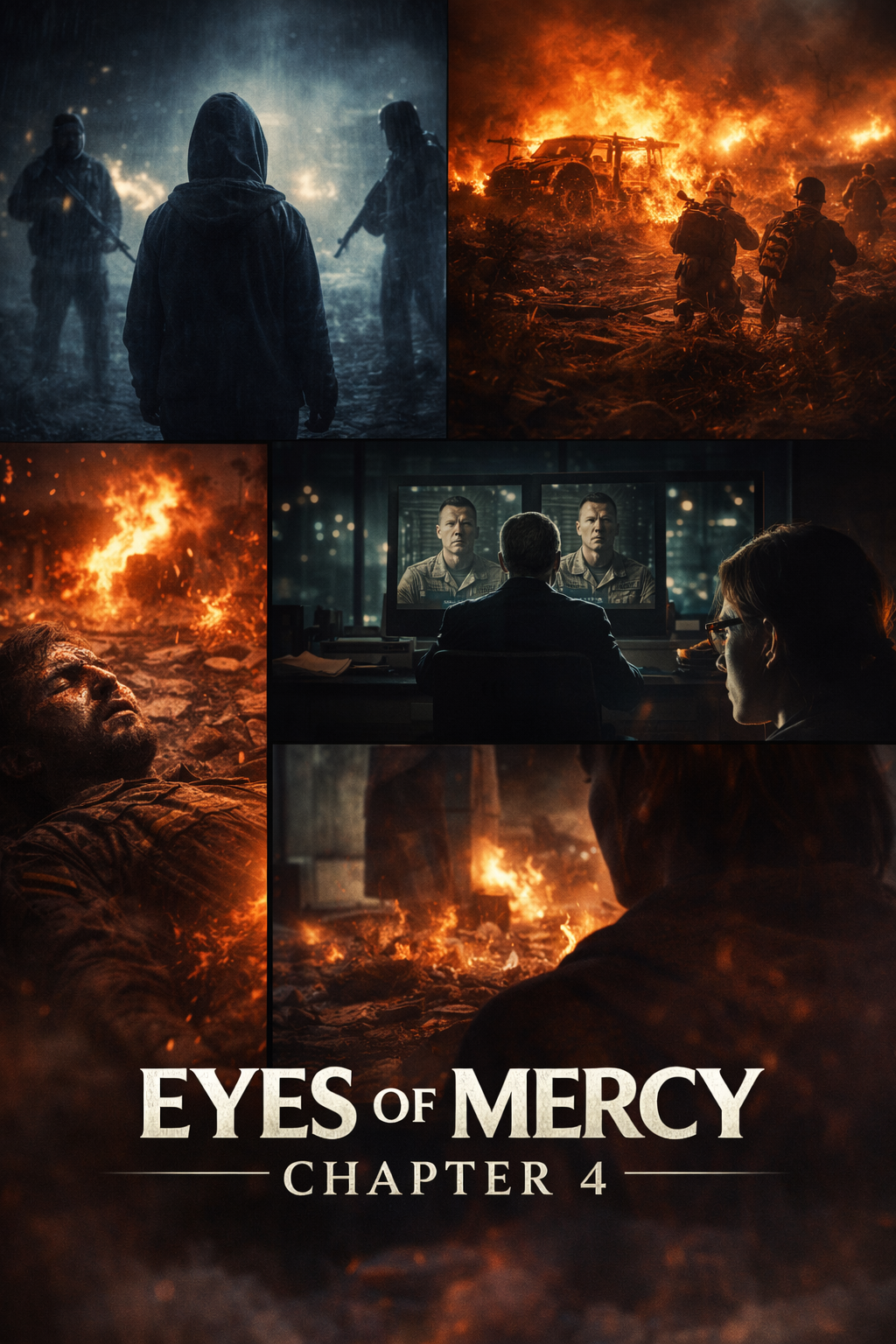
Eyes Of Mercy: Chapter 4 - Ashes and Replacements
Rain whispered against the old stone walls of the National Archives Annex as Simone followed Finch through the narrow sub-basement corridor. The lights overhead buzzed faintly, casting tired shadows across rows of sealed boxes that smelled of dust and history.
Her body was finally beginning to feel the weight of the night.
Every muscle ached from the dock fight. Her fingers still tingled from the recoil of the gun. The adrenaline that had kept her sharp was draining slowly, leaving behind a hollow exhaustion.
Finch walked ahead of her, clipboard tucked under one arm, shoulders hunched like a man carrying something heavier than papers.
“This place is safe,” he said quietly. “No cameras in the lower wing. Only maintenance staff ever come down here.”
Simone nodded, though something in her stomach twisted.
“Your family?” she asked. “You said you could get them somewhere safe.”
Finch hesitated for just a second.
“Already done,” he said. “They’re gone. Out of the city. No trace.”
Relief washed through her.
At least someone would be safe.
They entered a small records room tucked behind metal shelving. A single lamp glowed on a folding table. Two chairs faced each other like an interrogation setup.
Finch gestured for her to sit.
“You should rest for a minute,” he said. “You’ve been running all night.”
Simone sat slowly, keeping her back straight.
“Finch,” she said quietly, “you’ve been incredible through all of this.”
He gave a small, nervous smile. “I told you I had your back.”
She reached into her pocket and placed the Mercy Flight patch on the table between them.
“This is proof,” she said. “Once we connect it to Hawke and the shipment records—”
“We will,” Finch said quickly. Too quickly.
Simone noticed.
Finch’s hands shook as he set the two cups of tea on the small folding table.
Steam curled upward, carrying the faint scent of herbs and honey.
“I made it the way you like,” he said softly.
“You didn’t have to do this,” she said, as she started to sip.
“I do,” Finch whispered.
She nodded.
They sat across from each other.
For a moment, it felt like two friends sharing calm in the middle of chaos.
Simone lifted her cup.
“To truth,” she said softly.
“To survival ,” Finch replied.
As she continued to drink.
The warmth spread quickly through her chest.
Too quickly.
Her fingers trembled.
“Finch…” she whispered.
“I’m here,” he said, tears forming.
He didn’t meet her eyes.
“I’m sorry,” he said.
The door behind her opened.
Two men stepped in the same tactical calm, the same controlled posture as the ones at the dock.
Mercy Flight.
Simone spun toward Finch.
“You said this place was safe.”
“It was,” Finch replied quietly. “For my family.”
Her heart pounded.
“They came to you,” she realized.
“They said if I didn’t help,” Finch swallowed hard, “my parents and sister would disappear. No bodies. No explanation.”
“You believed them?” Simone demanded.
“They showed me photos,” he said, voice cracking. “Addresses. Schedules. My mother leaving work. My sister at school.”
The men approached slowly.
One raised a gun.
Simone backed away.
“Finch,” she whispered, hurt cutting deeper than fear. “You know what they are.”
“I know,” he said, tears filling his eyes. “But I also know I can’t lose my family.”
Finch’s voice shook. “I’m so sorry.”
Simone looked at him one last time.
Not angry.
Heartbroken.
“You were brave,” she said softly. “Just not brave enough.”
Her vision blurred.
The cup slipped from her hand and shattered on the floor.
Simone gasped once, then collapsed.
Finch caught her before she hit the ground.
Her body went still.
The Mercy Flight men inspected the body.
One knelt beside her.
Checked her pulse.
Nothing.
Another scanned her with a handheld monitor.
Flat line.
“She’s dead,” the man said.
Finch broke down, sobbing.
“I want to bury her,” he cried.
One man scoffed. “Do whatever you want with her. She’s nothing now.”
They turned and left.
Finch held her lifeless body, shaking.
“I’m sorry,” he whispered.
And the door closed.
Overseas Jordan and his unit enter the scene for their mission
The village was quiet in the way only places about to break were quiet.
Jordan’s convoy rolled through narrow dirt roads flanked by stone buildings and low roofs. Smoke from cooking fires curled into the pale morning sky. Chickens scattered as the vehicles passed.
The mission briefing had been thin.
Capture a dangerous suspect.
High threat.
Minimal collateral.
Jordan didn’t like the lack of detail.
“Eyes open,” he muttered into the radio.
His men spread out as they dismounted.
The building they were supposed to enter sat at the end of the road — dark windows, rusted metal door.
Reyes moved beside him.
“Feels wrong,” Reyes whispered.
Jordan nodded slightly.
They approached.
Jordan reached for the door—
And hell erupted.
Gunfire tore through the air.
An explosion ripped through the vehicle behind them, sending fire and metal screaming into the sky.
Men shouted.
Someone went down.
Jordan dragged Reyes behind a low wall as bullets shattered stone above them.
“They were waiting!” Reyes yelled.
Jordan scanned the rooftops.
Silhouettes.
Disciplined.
Not civilians.
Not enemy militia.
These were trained soldiers.
American formations.
His blood went cold.
“This is a setup!” Jordan shouted.
Another explosion rocked the building.
Flames burst through the windows.
The structure caught fire fast — too fast.
Accelerant.
More gunfire.
Jordan felt something slam into his shoulder.
Then another shot tore through his side.
Pain exploded.
He stumbled, firing blindly as smoke filled his lungs.
A third bullet hit his leg.
He collapsed behind the wall, vision blurring.
Around him, his squad fell one by one.
The attackers moved through the chaos, finishing anyone who twitched.
Jordan tried to crawl.
Fire spread.
The building roared.
Smoke swallowed everything.
A shadow loomed over him.
A man raised a weapon.
Then everything went black.
The next morning on the opposite side of the sea.
Colonel Hawke stood in his office as reports streamed in.
“Village operation resulted in full unit loss.”
“Structure fire confirmed.”
“No survivors identified.”
Hawke closed his eyes slowly.
A perfect tragedy.
“Proceed,” he said calmly.
Hours later, in a secluded military compound far from the blast zone, Jodan Lawson stood in a dark room wearing one of Jordan’s uniforms, no light was present except the glow of a single monitor.
His hair was singed.
His face bruised.
Blood streaked his temple.
But his eyes were sharp.
The air smelled like disinfectant and iron.
A medic finished wrapping his ribs while another wiped dried blood from his temple.
None of them spoke.
They didn’t need to.
Across the room, a large screen flickered.
Static rippled once.
Then Colonel Hawke appeared.
Not in uniform this time — just a dark undershirt, sleeves rolled to the forearms, posture relaxed like a man overseeing inventory.
“Status,” Hawke said calmly.
A soldier stepped into frame.
“Ambush executed, sir. Unit neutralized. Structure destroyed. No witnesses.”
“And Captain Lawson?” Hawke asked.
A beat.
“Presumed dead at site.”
Hawke nodded slowly.
“Good.”
His gaze shifted to Jodan.
Jodan met it without flinching.
“Brother,” Hawke said quietly.
Jodan’s jaw tightened.
“He was always the hero,” Jodan muttered.
Hawke studied him.
“He was always visible,” Hawke corrected. “You’ve always been useful.”
Silence stretched.
Hawke leaned closer to the camera.
“This only works if it’s perfect,” Hawke said. “From this moment forward, you are Jordan Lawson.”
Jodan inhaled slowly.
“What about the injuries?” he asked.
“They must look real,” Hawke replied. “Pain makes stories believable.”
Hawke nodded offscreen.
Two soldiers stepped forward.
“Begin conditioning.”
They didn’t rush.
One grabbed Jodan by the collar and slammed him into the concrete wall.
His breath exploded from his lungs.
Another punched him hard across the ribs.
Jodan grunted but didn’t resist.
Blow after blow landed — not wild, but calculated.
Bruises bloomed.
Blood pooled at the corner of his mouth.
The medics stepped in briefly between rounds — checking vitals, wiping blood, making sure nothing fatal happened.
Then it continued.
On the screen, Hawke watched without emotion.
“Harder,” Hawke said calmly. “Jordan would have fought.”
A fist slammed into Jodan’s jaw.
His head snapped sideways.
“Good,” Hawke murmured.
After several minutes, Hawke lifted a hand.
“Enough.”
Jodan sagged in the chair, chest heaving.
Hawke’s eyes remained sharp.
“Now the wound.”
A soldier raised a rifle.
Jodan swallowed.
“Shoulder only,” Hawke instructed.
The shot cracked like thunder.
Pain ripped through Jodan’s arm.
He screamed — real and raw — collapsing forward.
Blood soaked into the uniform.
The medics rushed in immediately, pressing cloths against the wound.
“Perfect,” Hawke said quietly.
The screen shifted to another camera feed.
News footage already rolling.
Smoke rising from the village.
Burned vehicles.
A reporter’s voice echoing:
“Breaking news from overseas — a devastating ambush has wiped out an entire U.S. military unit…”
Hawke lookedേഴ്
“By morning,” Hawke said, “you will be the lone survivor pulled from the wreckage.”
Jodan looked up through pain.
“And my brother?”
Hawke paused just long enough to sound human.
“He died a hero,” Hawke said softly.
A lie wrapped in respect.
Hawke continued:
“Doctors will announce you were critically injured. Memory loss will be suggested. Trauma will explain anything you don’t know.”
Jodan nodded slowly.
“They’ll believe it?”
“They already want to,” Hawke replied. “The public loves a survivor.”
The screen shifted again — now showing a prepared hospital room, reporters gathering outside.
Hawke leaned forward.
“You will speak Jordan’s history,” he said. “His training. His values. His love for this country.”
Jodan clenched his jaw.
“And Simone?”
Hawke’s expression didn’t change.
“The journalist will be confirmed dead,” Hawke said. “Her evidence will disappear with her.”
Silence filled the room.
Hawke softened his tone.
“This is bigger than you,” he said. “Bigger than me. It protects everything.”
Jodan stared at the floor.
“I’ll do it.”
Hawke nodded once.
“Good.”
The screen flickered as the call prepared to end.
“One more thing,” Hawke added.
Jodan looked up.
“From this moment forward,” Hawke said quietly, “you are Jordan Lawson.”
The monitor cut to black.
Less than 48 hours later the lie goes public
News screens across the world lit up.
HERO SOLDIER SURVIVES DEADLY AMBUSH
CAPTAIN LAWSON sole survivor of overseas attack
Photos showed Jodan on a stretcher — bruised, bloodied, eyes closed.
Medals were promised.
Interviews scheduled.
Speeches planned.
A symbol of sacrifice.
Hawke watched calmly, as his plan was working out smoothly.
Jodan became his shining metal for the world.
Smoke still clung to the air days later when an older man and a young woman moved carefully through the wreckage of the burned village.
Bodies lay scattered.
The woman gasped softly.
“Papa… this one’s barely breathing.”
The old man hurried over.
Jordan lay barely alive, burned, bleeding, unconscious.
“Help me lift him,” the man said urgently.
They carried Jordan away from the flames, into a small stone house hidden behind the village.
The woman cleaned his wounds while her father stitched what he could.
Jordan drifted in and out of darkness.
Faces blurred.
Voices unfamiliar.
Pain everywhere.
Days passed.
Weeks.
Months.
His body healed slowly.
But his mind didn’t.
Names slipped away.
Memories fractured.
Sometimes he whispered:
“Christine…”
But he didn’t know why.
Until one night over a year later all his memories started to slowly come back to him.
Vengeance filled his eyes and sight.
Hawke stood alone in his office again.
The city bustled beneath him, unaware.
Two problems eliminated.
One replacement installed.
“Phase Two complete,” he said to a voice said through his earpiece.
Hawke allowed himself a breath.
“Good,” the voice responded, “Now we build the future.”
