
Blog Post Title Four (Copy) (Copy) (Copy) (Copy)
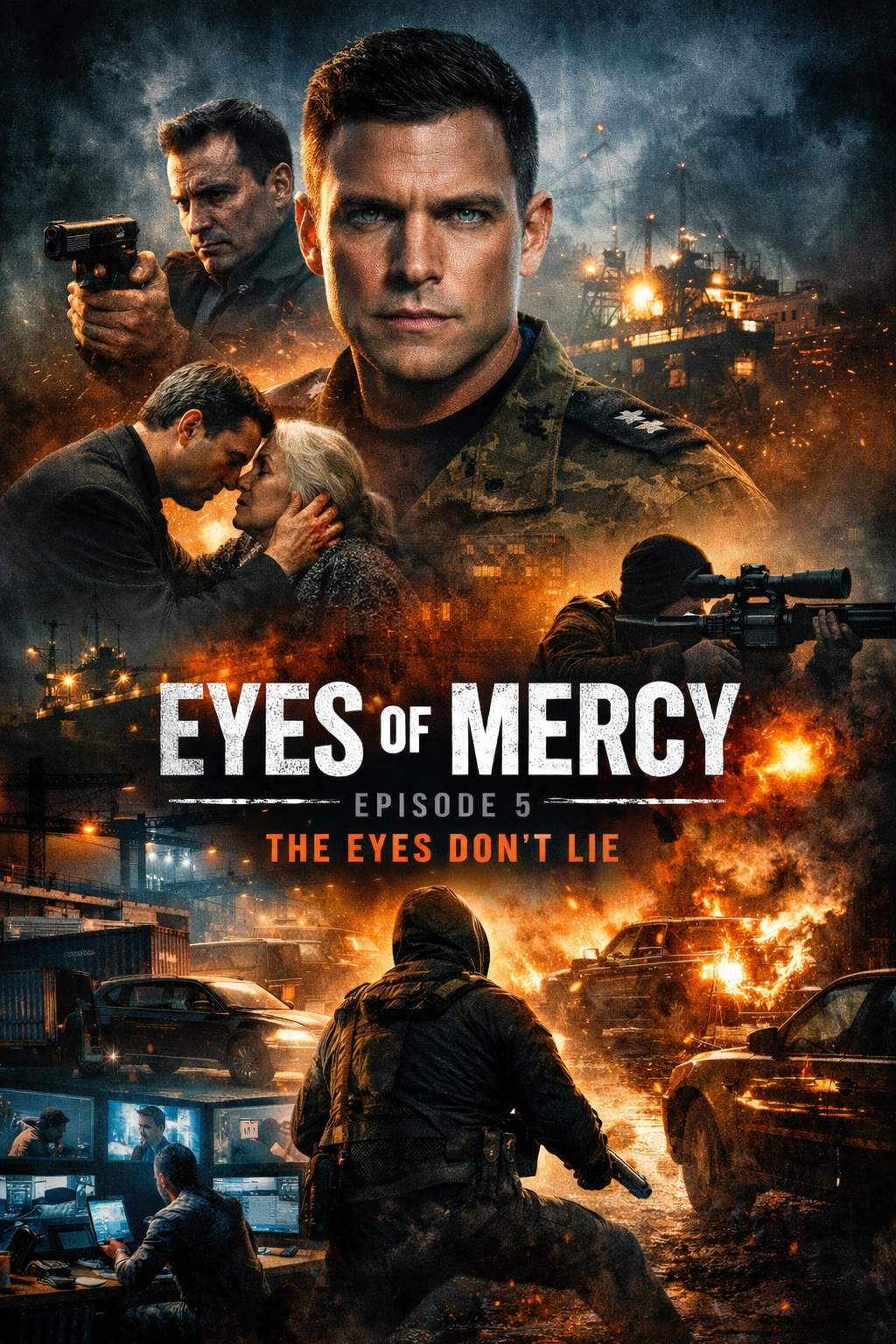
Episode 5: The Eyes Don’t Lie
Six months had passed, and the world had done what it always did after tragedy: it learned to live with the headline.
The studio where Captain Jordan Lawson “the survivor” was scheduled to speak looked nothing like war. It smelled like warm cables and clean makeup, like polished floors and coffee that had sat too long under a heat lamp. Light panels hovered overhead in neat geometric rows, softening every shadow, brightening every angle, turning pain into something palatable for the camera. People moved with quiet purpose, clipping microphones onto lapels, smoothing the folds of fabric, checking earpieces as though the truth could be calibrated with technology.
Jodan Lawson sat beneath the lights in Jordan’s skin. The uniform fit his shoulders with the ease of a man who had worn it for years, though he hadn’t, not like Jordan had. His posture had been rehearsed into muscle memory: relaxed enough to look healed, firm enough to look disciplined. There was no bandage now, no visible injury, only a faint stiffness that could be interpreted as trauma lingering in the bones. The anchor across from him held her cue cards delicately, her voice already lowered into the tone reserved for heroes and widows.
“Captain Lawson,” she began, “the nation watched you rise from the ashes of a devastating ambush. How does someone carry survival and loss at the same time?”
Jodan folded his hands in his lap and let a controlled pause stretch out just long enough to feel sincere.
“I don’t think you carry it,” he said quietly. “I think it carries you.”
The room softened around him. A few crew members exchanged glances—that was good, their eyes said. He spoke of the village the way Hawke had taught him to speak of it, with enough detail to create images, not enough to invite questions. Dawn light breaking over rooftops. The sound of boots on gravel. The shock of the first blast. The sudden, sickening realization that a mission could be a trap. He described his team in broad strokes that sounded loving and respectful, and when the anchor prompted him—what did you think in the moment you realized you might die—he looked down at his hands as if seeing blood there.
“I thought of my men,” he said, voice thickening at the edges. “I thought of how I’d promised their families I’d bring them home.”
He paused again, and the silence did the work.
“And your fiancée,” the anchor said gently, as if she hated the question but had been hired to ask it anyway. “Investigative journalist Simone Lawson. The country mourned with you when she died.”
Jodan’s throat tightened. Not grief—something closer to pressure, like a collar being pulled too tight.
“She believed in the truth,” he said. “Even when the truth was dangerous.”
The anchor reached across the small table and touched his forearm briefly, a gesture meant for the viewers more than for him.
“How are you holding up?” she asked.
Jodan lifted his gaze to the camera lens, steady and practiced, letting the world see what it wanted to see.
“Some days,” he said, “I wake up and I don’t understand why I’m still here. And then I remember… I’m here to honor them. To honor her. I owe them that.”
The recording light blinked off. The room exhaled. Applause broke out, scattered at first and then fuller, people clapping with the relieved warmth of anyone who had just witnessed a tragedy wrapped neatly in redemption. The producer mouthed, “Beautiful,” as technicians powered down the cameras, and for a moment Jodan stood there with a calm smile, as if stepping out of someone else’s life was as easy as leaving a chair.
He turned to shake a few hands, accepted a bottle of water, gave a short “thank you” to the anchor, and followed a security guard down a corridor lined with posters about resilience and recovery. His phone vibrated as he reached the side exit, but he ignored it until he was outside and the cold air had bitten through the warmth of studio lights. The city smelled like wet pavement and exhaust, rain lingering in the cracks of concrete. He glanced back once at the building tinted glass, quiet interior, the last of the crew filing out.
Across the street, beyond the glare of streetlights, a figure stood still under the awning of a closed storefront.
The hood was pulled low, but the posture was unmistakably deliberate. The figure didn’t pace or fidget the way anxious people did. Didn’t pretend to scroll a phone or smoke a cigarette. Just watched, unmoving, as if the lie being told inside the studio had weight and shape and could be measured from a distance.
Jodan’s transport car pulled up. He stepped into the backseat. The door shut. The engine rolled.
The figure stayed.
Only when the car vanished into traffic did the hood lift slightly, revealing a slice of face and eyes that held no softness at all.
“That’s not him,” the figure whispered, and the words disappeared into the night like smoke.
The call came before Jodan reached the highway. It wasn’t surprising—Hawke never let the momentum of a performance cool without immediately turning it into another tool.
“You did well,” Hawke said, voice smooth through the phone, as if it were an ordinary check-in instead of a leash tightening.
“It went how you wanted,” Jodan replied, staring out the window at the blur of city lights.
“There’s something else,” Hawke continued. “The psychiatric facility has contacted us repeatedly. Your mother is asking for you.”
Jodan’s jaw tightened. “I haven’t seen her in years.”
“Exactly,” Hawke said, and there was the faintest hint of impatience behind the calm. “It reinforces stability. No cameras will be allowed. But gossip is a camera. People will know you visited. It strengthens the narrative.”
“I don’t think—” Jodan began.
“I wasn’t asking,” Hawke cut in gently, which was worse than shouting because it meant the decision had already been made. “Go tonight.”
The line clicked dead.
The driver didn’t ask questions. He changed direction without comment, steering toward the northern edge of the city where the streets widened and the buildings grew older, brick and ivy and time. As they drove, Jodan felt something he hadn’t expected—a creeping discomfort, not about the visit itself but about the idea of being seen by someone who had known Jordan before the lie. Cameras could be tricked. Reporters could be managed. But mothers… mothers were different. Mothers lived in the small details no one else bothered to memorize.
The psychiatric hospital rose from the darkness like a monument built to hold grief in place. The windows glowed unevenly behind drawn curtains. The lobby smelled faintly of antiseptic and burnt coffee, and the air carried a tired hum, as if the building itself never rested. A nurse greeted him with a smile that trembled at the edges.
“Captain Lawson,” she said, scanning his ID. “She’s been asking about you all week. Some days are better than others.”
He followed her down a narrow hallway where doors shut softly behind them and voices came muffled through walls. Somewhere farther down, a television played an old sitcom laugh track that didn’t match the heavy air. A man laughed too loudly and then began to cry, the sound rising and falling like a wave. The nurse paused at a door and pressed the handle gently, as if trying not to disturb whatever fragile peace existed inside.
“She’s having a good day,” the nurse whispered.
Jodan stepped into the room.
His mother sat near the window, knitting something uneven in pale yarn, her hands moving steadily as though routine was the only thing holding her together. She looked smaller than he remembered from Jordan’s memories, the lines around her mouth deeper, her hair threaded with gray. For a moment, she looked up and her face brightened so suddenly it startled him, pure happiness blooming across sorrow, as if her heart had been waiting in the dark for this one light.
“Jordan?” she breathed.
“Yes, Mom,” he said softly, and he tried to make his voice warm.
She stood too quickly, tears already forming, and crossed the room with a kind of trembling urgency. When she hugged him, the embrace was fierce—desperate, almost—as if she feared he would evaporate.
“You’re here,” she whispered into his shoulder. “You’re really here.”
He held her carefully, feeling the thinness of her arms, the fragile shape of her bones. When she pulled back, she touched his face with trembling fingers, her eyes studying him with a softness that made his stomach twist.
“You look thin,” she said. “They didn’t feed you enough.”
He managed a faint smile. “They tried.”
She laughed a small laugh, real and the sound was so normal it hurt.
They sat down, and for several minutes the conversation flowed with the ease of two people trying to pretend the world hadn’t broken. She asked about his recovery. He spoke about physical therapy, about pain that lingered, about learning to sleep without hearing explosions behind his eyelids. She cried when Simone’s name came up, and the grief seemed genuine enough to swallow the room.
“She was good for you,” his mother said, wiping her cheek. “She made you softer. She made you… more you.”
Jodan nodded carefully. “She did.”
His mother clasped his hands between hers, as if anchoring him. “You always loved too hard,” she said gently. “That’s your gift and your curse.”
He swallowed. It sounded like something a mother would say. It sounded like Jordan. It sounded like danger.
She talked about small things, how the food here tasted like cardboard, how the nurses were kind, how she’d started sleeping better. She told him she prayed every day. She told him she knew he would come back even when no one else believed it.
“I knew,” she said, eyes shining. “I told them my boy isn’t gone.”
Jodan’s chest tightened, and for a moment he almost believed she was speaking to him as if he were Jordan, almost.
Then she leaned forward slightly, the light from the window catching her face, and her expression shifted.
Not abruptly. Not dramatically.
Like a lamp dimming.
“Look at me,” she whispered.
He lifted his eyes.
She stared at him, not at his mouth or his hair or the familiar map of his face, but deep—into his eyes—like she was searching for something that could not be faked.
Her smile disappeared.
“No,” she murmured.
“Mom?” Jodan asked, voice tightening.
She stood slowly, backing away as if he had become something dangerous.
“Your eyes,” she said.
His throat went dry.
“My Jordan’s eyes could be angry,” she said softly, voice trembling. “They could be tired. They could be broken. But there was always love in them. Always.”
She stepped closer again, and when she spoke this time, the softness was gone.
“Yours are empty.”
Jodan stood, hands raised slightly as if calming a frightened animal. “You’re confused.”
She shook her head violently. “No.”
Her hands trembled harder.
“You’re not my son,” she said, and the words hit the air like glass shattering. “You wear his face, but your soul is wrong.”
He tried to speak, but she spoke over him, voice rising, panic and certainty twisting together.
“You’re Jodan,” she said.
The name said aloud was a blade.
Jodan froze.
She pointed at him, her voice turning harsh. “You’re a demon anchored by the devil.”
The nurses rushed in at the sound of her shouting, their hands gentle but firm as they moved toward her, murmuring soothing words. His mother fought them, her eyes wild now, locked on him like she was trying to burn the truth through his skin.
“Where is my son?” she screamed. “What did you do with him?”
Jodan backed toward the door, breath shallow, heart pounding in a way it never had under studio lights.
As he stepped into the hallway, her final words followed him—prophetic, furious, unwavering.
“You can wear his life,” she called after him, “but it will eat you!”
The door shut. The hallway swallowed the sound. Jodan stood there shaking, and for the first time since stepping into Jordan’s skin, he didn’t feel powerful.
He felt exposed.
He felt hunted.
The first siren Hawke heard that night came from the port.
He arrived with his coat still half-buttoned, stepping from his SUV into the harsh floodlights that turned fog into a white veil. The docks were chaotic men shouting into radios, forklifts stalled mid-task, security personnel running in tight lines that looked organized until you saw the panic in their movements. Containers stood open like mouths, their contents gone. Not everything, only the crates stamped with internal codes Hawke had written himself.
A supervisor approached, voice trembling. “Sir, the cameras looped. Exactly nine minutes. No alarms.”
“How?” Hawke asked, voice low and dangerous.
“We don’t know. But whoever did it—”
“They knew where to go,” Hawke finished.
The next hit came before sunrise.
A private warehouse on the industrial edge of the city went dark—power outage only in that building, only on the floor where encrypted comms equipment was stored. The generator backup failed as if it had been instructed to fail. When Hawke’s men arrived, the doors weren’t broken. The locks weren’t forced.
But the racks were empty.
Then the financial calls began.
A holding company dissolved overnight, paperwork filed so cleanly it looked legitimate. Offshore transfers froze mid-transaction, flagged by audits that didn’t exist the day before. A supplier terminated a contract citing “risk exposure.” Another refused to load shipments because their system suddenly believed Hawke’s cargo was tied to an ongoing investigation.
By noon, Hawke’s phone rang so often it became a pulse.
“Sir, Zurich account flagged.”
“Sir, Rotterdam port denied clearance.”
“Sir, our manifest was sent to an international watchdog group.”
“Sir, your name has appeared in an anonymous tip.”
Hawke stood in his office above the city, rain streaking the windows, and watched his empire crack not with one big explosion but with precise, intelligent cuts—arteries severed one at a time. Someone wasn’t vandalizing him.
Someone was dismantling him.
Someone understood what mattered most, what could not be replaced quickly, what would force attention.
They knew how he moved.and more unsettling than that they knew what would make him visible.
The black room meeting came that evening, called not with a formal invitation but with a message so short it felt like a threat.
NOW.
The room was windowless and cold, walls swallowing sound. The table was circular, the chairs spaced evenly like judgment. Hawke stood at the center while voices spoke from the shadows, layered and calm, each one a different weight pressing down.
“You assured us your structure was invisible,” one voice said.
“It was,” Hawke replied, keeping his own voice steady. “Until someone interfered.”
“You do not know who,” another said.
“It is targeted sabotage,” Hawke snapped. “Not random chaos.”
“What has been lost?” a voice asked.
Hawke chose his words carefully, because in this room words could become sentences.
“Two shell entities. One logistics corridor. Partial exposure of manifests.”
“And your confidence,” someone said, almost amused.
Hawke’s jaw tightened. “Give me time.”
“How much?” a voice asked.
“Forty-eight hours.”
A pause—short, sharp.
“For you,” one voice said calmly, “forty-eight hours is a lifetime.”
Hawke stepped forward. “You will have a name.”
“If you do not,” another voice said, colder now, “you will be the liability that gets removed.”
Silence pressed down, and Hawke felt it—how close power was to cruelty, how easily a protector could become a sacrifice.
The call ended without goodbye.
Hawke walked out furious, heart pounding with anger and something else—an unpleasant thrill. It had been a warning, yes. But it was also recognition. They were afraid enough to call him in.
That meant the attacker was real.
That meant the game had shifted.
He called for his car.
Security moved in formation around him as he exited the building into night air that tasted sharp and electric. Two vehicles waited—an escort car in front, his SUV behind. Standard protocol. Standard safety. Standard illusion.
Half a block down, a car exploded at the corner.
The fireball bloomed bright against the dark, heat rolling across the street, a shockwave that rattled windows and sent pedestrians screaming. Hawke’s security tightened instantly, bodies forming a shield as they moved him quickly into the SUV.
“Route change,” the driver barked.
They turned.
The explosion had blocked the one-way street they needed. The driver cursed and took a detour, the escort vehicle staying tight in front like a guard dog. The city grew quieter as they moved away from the bright areas into streets with fewer eyes, fewer cameras, fewer witnesses. Rain began again, light and cold.
A red light stopped them in an open intersection where the world felt paused—no cars, no pedestrians, only the hum of distant traffic and the quiet hiss of wet pavement.
A homeless man approached the driver’s window, cup extended.
“Please,” the man called. “Just—anything.”
Security waved him off. “Get back.”
The light changed to green.
The man dropped his bag as if startled, bending to pick it up, moving too slow.
The driver honked. Harsh. Annoyed.
The man stepped out of the way.
Half a block ahead, the escort car detonated.
The blast lifted it like a toy, flipping metal and glass into the air. Heat hit Hawke’s SUV like a punch. The driver slammed the brakes. Smoke rolled in thick waves, and for a fraction of a second Hawke saw silhouettes moving in the haze—purposeful, trained.
“Reverse!” security shouted.
The driver threw the SUV into reverse.
Then the sanitation truck behind them accelerated.
A massive, rumbling beast of steel that should have been slowing, not speeding.
It slammed into the rear of the SUV with a crunch that folded metal inward. Hawke’s body lurched. The smell of gasoline and burning rubber flooded the cabin. Security fired out the windows, blind shots into smoke.
The truck pushed again, shoving the SUV forward like it was trying to crush it into the wreckage ahead.
Hawke’s security dragged the rear doors open.
“Out, move!” one shouted.
Hawke stumbled onto wet pavement. The night spun.
Gunfire snapped through the smoke.
His security men pivoted, trying to form cover.
Two of them moved to Hawke’s side at the same time, shoulders pressed close, hands on his arms.
Then a suppressed shot sounded—small, almost gentle.
One security man collapsed instantly, his head snapping back.
A second suppressed shot.
The other dropped before he could even turn.
Hawke stood frozen for half a heartbeat, staring at their bodies like the world had become unreal.
He reached for his phone.
It was gone.
His pocket was empty.
The smoke thickened. Footsteps moved somewhere nearby. Not running. Not panicking.
Approaching.
Hawke backed away, boots slipping in wet grit, his breath loud in his own ears. For the first time in years, there was no chain of command to hide behind. No office. No men. No distance.
Only him.
And the night closing in.
Miles away Finch worked in a space that looked like a warehouse from the outside and a nightmare of screens from the inside. Cables ran like veins across the floor. Monitors glowed in rows. Hard drives blinked. The air smelled faintly of warm electronics and stale coffee.
He sat hunched at a desk, fingers flying as he pulled camera feeds from traffic intersections, storefront security, dash cams, and phones that had recorded the explosions without knowing what they’d captured. His facial recognition program stitched the city together frame by frame, building a living map of movement.
“Come on,” Finch muttered, eyes bloodshot. “Show me the ghost.”
His program flagged a face.
Unfamiliar at first—hood up, posture deliberate.
Then the hood lifted slightly in one frame, and Finch’s stomach dropped.
He zoomed in. Enhanced. Cross-referenced.
His lips parted.
“Jordan,” he whispered.
A voice answered from behind him—calm, steady, alive.
“Yes.”
Finch spun.
Simone Lawson stepped into the blue glow of the monitors as if she belonged to it. Her face was thinner than before, her eyes sharper, her presence quieter and somehow heavier. Not the woman the world had mourned.
Something colder.
Something reborn.
Finch stared at her like he was looking at a miracle he’d helped manufacture.
“You shouldn’t be—” he started, then stopped because the truth sat right in front of him.
Simone’s gaze went to the monitor, to the face Finch had flagged.
“That’s him,” she said softly.
Finch swallowed. “The man from the footage?”
Simone’s voice didn’t shake.
“No,” she said. “That’s my husband.”
Finch’s hands hovered over the keyboard, trembling. “But, Jordan is supposed to be—”
“Dead,” Simone finished, and the word sounded almost amused. “That’s what they wanted the world to believe.”
She leaned closer to the screen, studying the image as if memorizing it, as if imprinting it into her bones.
“And the one on television?” Finch asked carefully.
Simone’s mouth tightened.
“That’s not him,” she said. “That’s the lie.”
Finch’s chest rose and fell quickly. “So you did all of this”
Simone’s eyes stayed on the screen, and the city outside continued burning in small, precise fires.
“I waited,” she said quietly. “I watched. I mourned in silence so the world could mourn loudly.” She glanced at Finch, and there was something ruthless in the way she said it next. “Then I saw him on television wearing Jordan’s face.”
Her fingers curled slightly, as if around an invisible trigger.
“And that’s when I decided Hawke doesn’t deserve comfort.”
Finch looked back at the feeds Hawke’s convoy, the explosions, the reroute, the sniper shots.
“This is you,” he whispered, not as a question.
Simone nodded once.
“I want him exposed,” she said. “I want him to panic. I want every safety net he’s built to disappear.”
Finch hesitated. “If you push too hard, the Higher Ups—”
“Let them look,” Simone said softly. “The more they look, the more they see.”
Finch’s program pinged again another location, another angle.
Simone’s eyes flicked to it.
A month before everything was placed into motion outside, somewhere far from the glow of screens, in a remote village tucked into rugged terrain, a man with burned scars and rebuilt muscles lifted a weight made of stone and iron and forced his shaking body to hold it.
Jordan Lawson the real Jordan was learning his strength again, one painful day at a time, memory returning like blood to a numb limb. He didn’t know Simone was alive. He didn’t know his face was being worn by someone else.
But he knew one thing with a clarity that never left him:
Someone had tried to erase him and when he returned, he would make them remember.
Back in Finch’s lair, Simone watched Hawke’s world collapse in the glow of a monitor and let herself breathe, slow and controlled.
“Now we start the war.”
